Electrodeionization (EDI)
Electrodeionization (EDI) 101
The global increase in ecosystem pollution has created a pressing need for sustainable methods to remove contaminants. Among these, electrodeionization stands out as a highly effective technique for extracting ionic compounds from polluted water. Electrodeionization (EDI) is a ultra water purification technology that uses electricity, ion-exchange membranes, and resin to remove ionized molecules from water.
EDI is highly recommended for those aiming for environmental protection, the production of ultra-pure water, and for the recovery of some valuable species. The primary technical factors that determine the performance of an EDI module are the applied current, the flow rates in both the dilute and concentrate streams, the operating temperature, and the total dissolved solids (TDS) in the feed and product water.
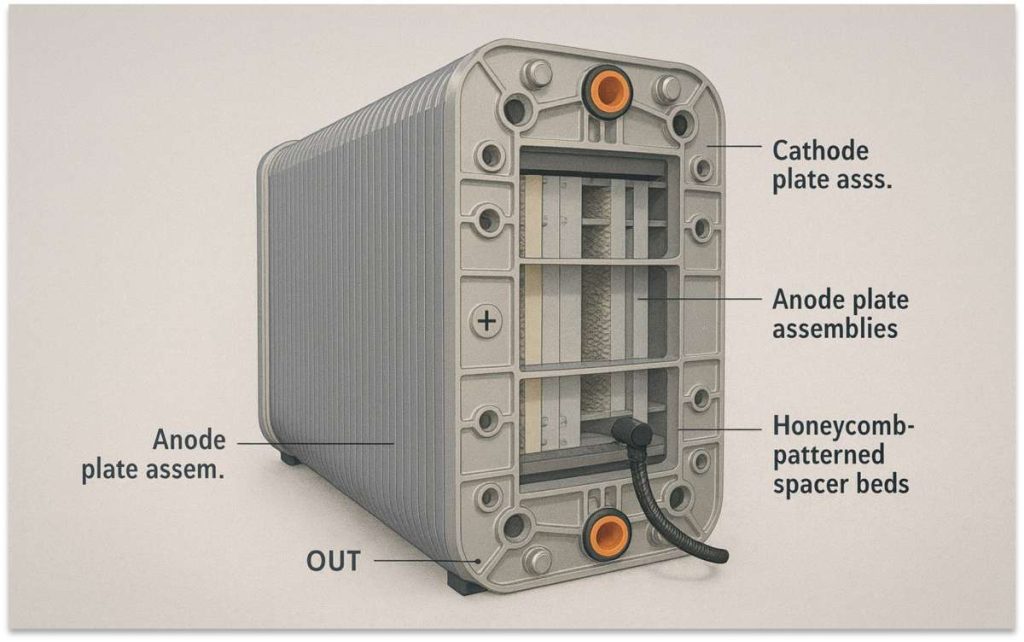
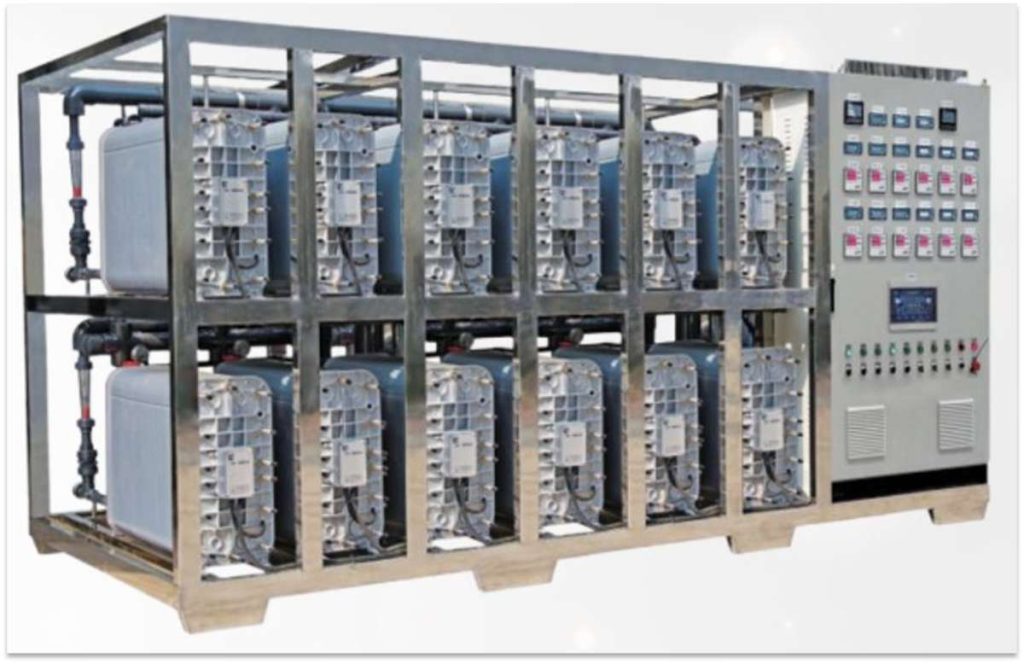 EDI is often described as an electrically-driven ion exchange process. Think of it as a hybrid technology that combines the best aspects of two classic methods:
1. Ion Exchange (IX): The ability to remove ions to a very high degree.
2. Reverse Osmosis (RO): A membrane-based, continuous process that doesn’t require chemical regeneration.
Traditional Mixed Bed Ion Exchange (MB) requires periodic regeneration using strong acids (e.g., Hydrochloric Acid) and strong caustics (e.g., Sodium Hydroxide). This process produces a large volume of highly concentrated, salty, acidic, and caustic waste stream that is:
● Expensive to Dispose Of: It must be treated as hazardous waste, requiring specialized handling and disposal services.
● An Environmental Burden: If not neutralized and managed correctly, this waste can be damaging to aquatic life and infrastructure.
● A Safety Risk: Storing and handling bulk acids and caustics poses a significant safety hazard to personnel.
EDI completely avoids this by providing consistent ultra-pure water while eliminating chemical waste generation. The “regenerant” is the H⁺ and OH⁻ ions produced in-situ from water splitting, not bulk chemicals delivered to the site. Notably, EDI doesn’t produce a hazardous waste stream; instead, it produces a concentrate or reject stream, which contains the salts, silica, weakly ionized compounds, and dissolved CO₂ removed from the feed water. This reject stream is typically sent to drain, reused in lower-grade applications, or blended with other wastewater for safe discharge, depending on the facility’s water-recovery design and local regulations.
Because it lacks these hazardous chemicals, it is typically classified as a non-hazardous, high-TDS (Total Dissolved Solids) wastewater. This makes its disposal much simpler, cheaper, and more environmentally safe. The concentrate stream is relatively small, often only 5-15% of the total feed flow to the EDI unit.
 Looking for EDI technology in Malaysia?
At Cubictech, we understand that your high-purity water system is the lifeblood of your operation. That’s why we supply proven, patented EDI modules engineered to maximize uptime & reduce TCO (Total Cost of Ownership). Our technology maintains a steady output of high-purity water , batch after batch, ensuring your process never varies.
With high rejection rates for tough ions like silica and boron, you can trust Cubictech modules for unparalleled performance in the most demanding applications. We offer diverse EDI solutions tailored for a broad range of industries. Get in touch with our experts for a custom quote!
Related Articles
- Chemical Dosing Skid And Manifold Malaysia
- Chemical Process Tank Malaysia
- Commercial Reverse Osmosis System Malaysia
- Commercial Wastewater Systems Malaysia
- Commercial Water Treatment System Malaysia
- Factory Waste Treatment Malaysia
- Gas Chlorination Systems Malaysia
- Industrial Effluent Treatment System (IETS) Malaysia
- Industrial Filter And Screens Malaysia
- Industrial Wastewater Solution / Systems Malaysia
- Industrial Water Purification Systems Malaysia
- Rapid Gravity Johnson Filter Screen (Customized Filter) Malaysia
- Sewage System Malaysia
- UV Industrial Water Treatment Malaysia
- Electrodeionization (EDI) Malaysia
- Ozone Nanobubble Malaysia
- Ozone System Malaysia
- Sodium Hypochlorite Generator Malaysia
-
- Well Filtration System Malaysia
- COB BOD Reduction Parameter Malaysia
- Department Of Environmental (DOE) Water Standard Submission Malaysia
- Industrial Water Treatment Malaysia
- Wastewater Engineering and Construction Malaysia
- Wastewater Management Plant Malaysia
- Water Treatment and Recycling Malaysia
- Effluent Treatment Plant Malaysia
- Heavy Metal Water Treatment Malaysia
- Industrial Reverse Osmosis System Malaysia
- Industrial Ultrafiltration (UF) System Malaysia
- Industrial Wastewater Treatment Malaysia
- Industrial Water Filters Malaysia
- Municipal Water Treatment System Malaysia
- POME Treatment Malaysia
- Portable Container Treatment System Malaysia
- Residential Water Treatment Malaysia
- Sealless Magnetic Drive Pump Malaysia
- Sewage Treatment Plant Malaysia
- Titanium Water Filter Cartridge Malaysia
- Water Treatment Automation Dosing System Malaysia
- Piping Tank Fabrication Installation Works Malaysia
- Wastewater and Water Treatment Design and Build Malaysia
- Wastewater Treatment Plant Design / Build / Commissioning Malaysia
- Wastewater Treatment Process Instruments Malaysia
- Water & Wastewater Treatment Malaysia